
Open Space Technology (often shortened to OST) is a facilitation method for meetings and multi-day gatherings where the agenda is largely created by the participants at the start of the event, rather than being fully pre-planned. It is designed for situations where there is genuine passion, complexity, and a need for self-organisation, so the “real work” can happen in parallel conversations that people choose for themselves - wikipedia 
# Origin story
OST is widely credited to Harrison Owen, developed in the early-to-mid 1980s, after he noticed that the most alive and valuable part of many conferences was the coffee breaks rather than the formal sessions. The method aims to turn that “coffee break energy” into the core structure of the event, while still holding everything around a clear theme or purpose. - wikipedia - involve.org.uk
# The four principles and the one law OST is commonly taught through four principles and one law that set expectations for participation and help people stop clinging to “meeting theatre.” The principles are: whoever comes are the right people, whenever it starts is the right time, whatever happens is the only thing that could have happened, and when it’s over it’s over.
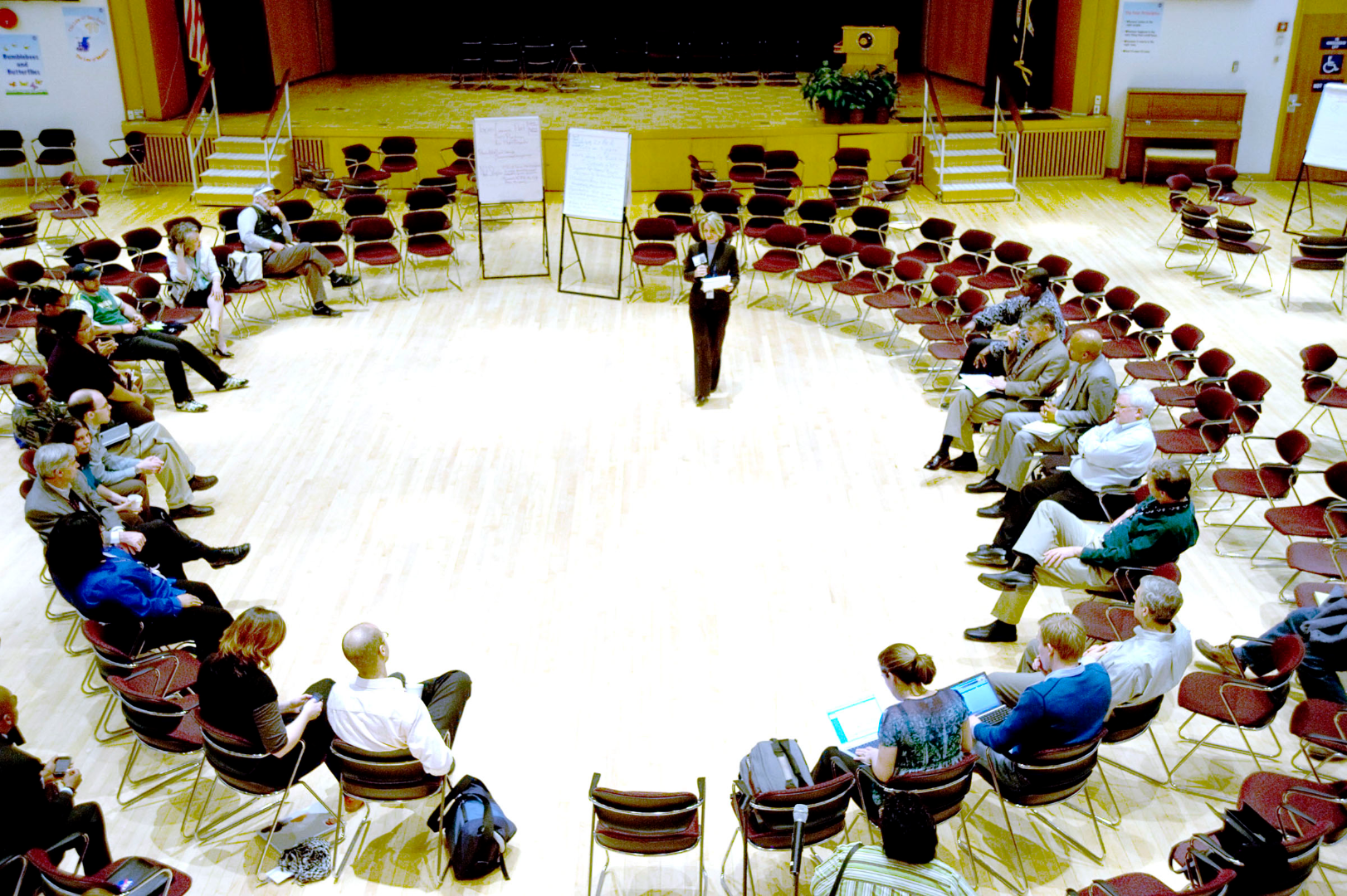
Remote image source 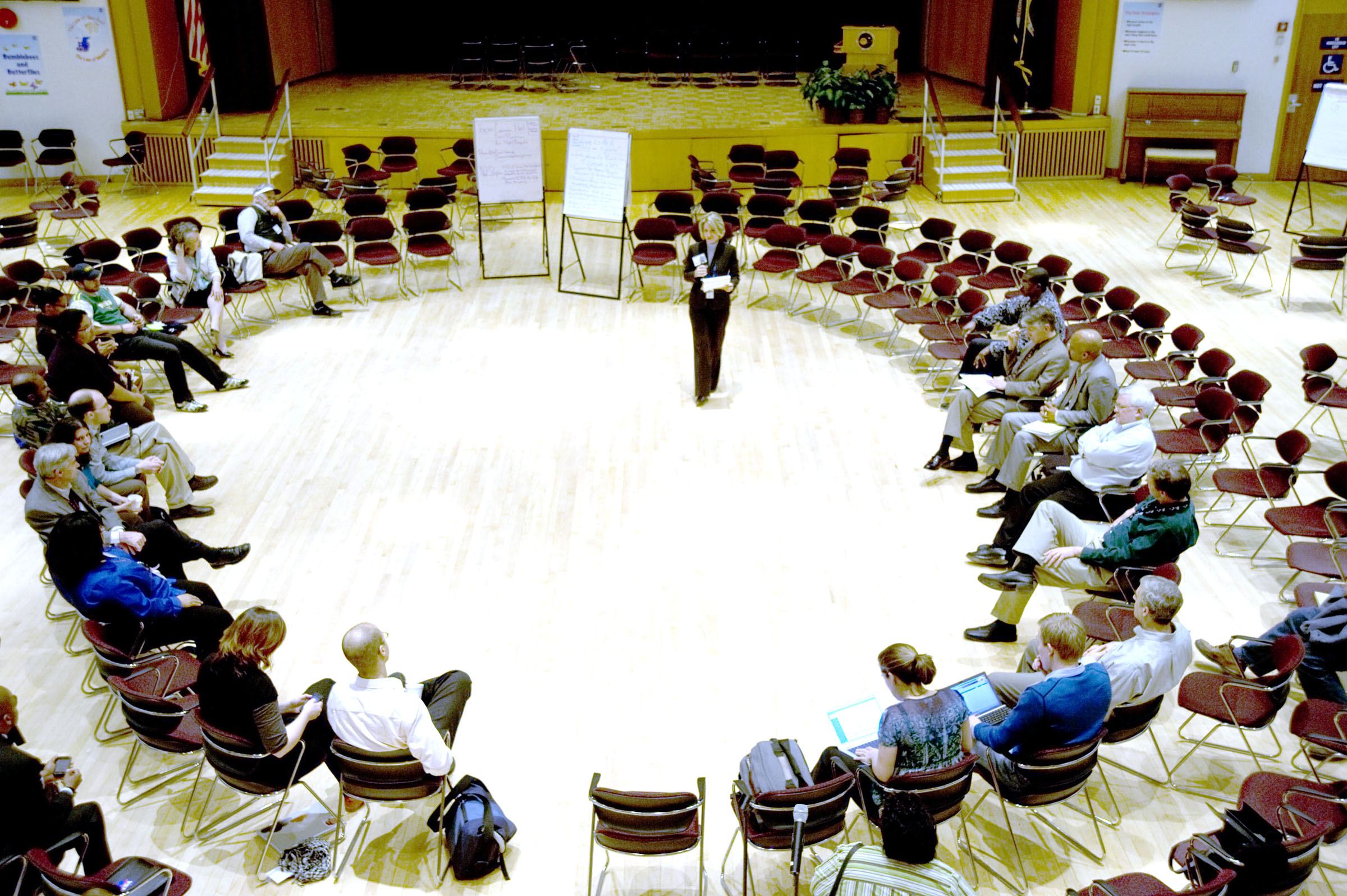
The “one law” is usually called the Law of Two Feet (also reframed as the Law of Mobility or the Right to Come and Go): if you find yourself somewhere you are neither learning nor contributing, it is your responsibility to move to a place where you can. This single rule creates a culture of consent, energy, and momentum, and it quietly removes the social glue that keeps unproductive meetings stuck - liberatingstructures.com
# What an OST event looks like
An OST gathering usually begins with a clear theme and an open invitation, followed by a simple “marketplace” where participants propose session topics and claim a time and space on a visible agenda grid. People then self-select into sessions, move freely between conversations, and capture notes as they go, so that the outputs become a shared record rather than private memories. - openspaceworld.org
Because the structure is lightweight, OST scales from small groups to very large gatherings, and it often produces a surprisingly rich “proceedings” document by the end, containing the agenda, session notes, and follow-up actions that participants care enough to own - openspaceworld.org
# When it works best OST works best when there is a real issue people care about, a diversity of perspectives, and enough uncertainty that a top-down agenda would be mostly guesswork anyway. It is especially useful when you want ownership and initiative to emerge from the group, not merely “feedback” on someone else’s plan. It tends to underperform when the outcome is already predetermined, when participants do not have meaningful agency, or when the culture punishes movement, dissent, or honest exploration. In other words, it fails in exactly the places where organisations try to pretend they want participation while actually wanting compliance.
# Roles and responsibilities The facilitator’s job in OST is less about controlling discussion and more about holding the container: naming the theme, explaining the principles and law, setting up the agenda wall, protecting the culture of movement, and ensuring note-capture and closing reflection happen. The participants’ job is to propose what matters, convene conversations, take notes, and take responsibility for whatever they want to happen after the event.
# Outputs and follow-through A classic OST anti-pattern is to treat the event as a “good conversation” and then dissolve back into normal life without follow-through. A simple improvement is to end with explicit harvesting: what proposals emerged, who is convening next steps, what decisions need to be made, and what will be communicated to people who were not in the room.
# Relationship to adjacent methods OST often sits alongside other participatory formats like World Café, Art of Hosting practices, and modern “menu” systems like Liberating Structures. In practice, teams frequently blend these approaches, using OST when they want self-organised parallel work, and other methods when they want more guided convergence or specific kinds of dialogue.
# Hitchhiker-style use cases For Hitchhiker-flavoured communities, OST is a practical way to turn “we should get together and build something” into an agenda that writes itself, while keeping the event human-centred and energy-led. It is also a strong fit for volunteer-heavy ecosystems, because it makes it socially legitimate to move toward where you can genuinely contribute, instead of performing attentiveness in the wrong room.
A neat pattern is to run OST as the “engine room” inside a larger story frame: a theme like Vibe Code the Future a playful opening ritual, then the marketplace, then a closing circle that turns session notes into commitments and shared artifacts.
# Further resources
A short practical starting point is the brief user guide hosted by OpenSpaceWorld, and the broader facilitator resources page that links to Harrison Owen’s library and related materials - openspaceworld.org - openspaceworld.org
# See - World Café - Art of Hosting and Liberating Structures - Self Organisation - Emergence and Wicked Problems - Federated Open Space