
The Art of Hosting (often shortened to AoH) is a global community of practice and a participatory leadership approach for convening and facilitating “conversations that matter,” especially in complex situations where no one person has the full answer. It treats facilitation less as “running a meeting” and more as hosting a living process that helps a group surface collective intelligence and move toward wise action - wikipedia 
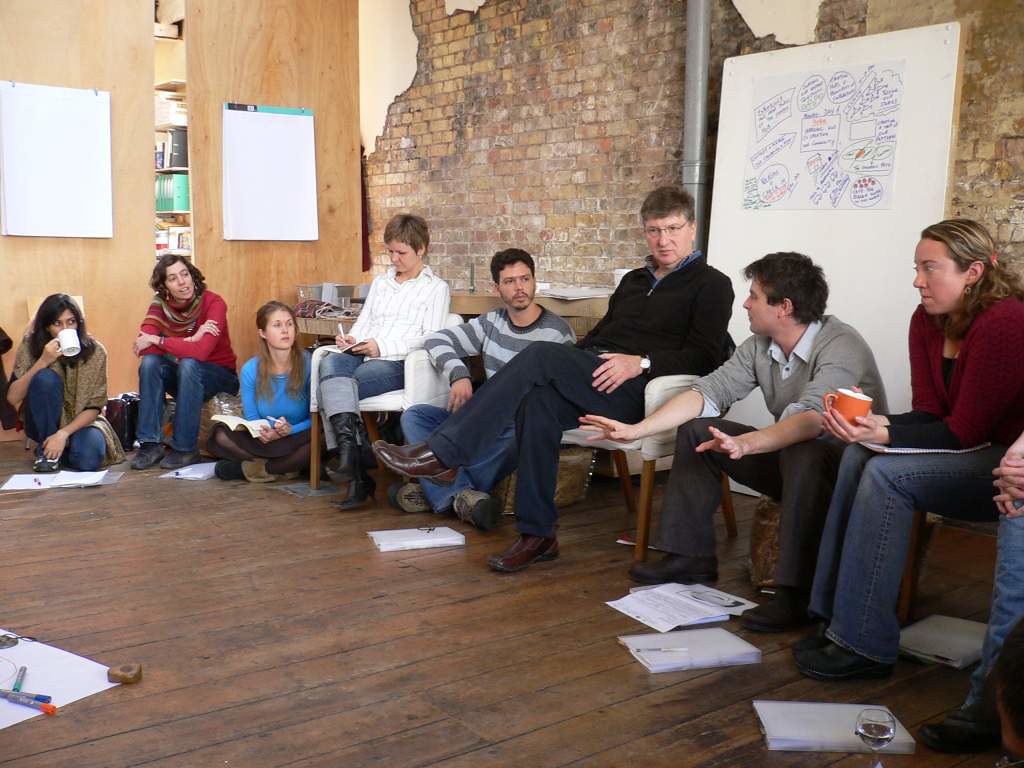
Art of Hosting Spaces for Social Innovation Event by Impact Hub
# What it is trying to solve
AoH starts from a blunt observation: many organisations are full of meetings that drain energy, hide conflict, and produce compliance rather than ownership. The Art of Hosting aims to flip that by designing conversations that invite participation, distribute leadership, and make it normal for people to think together, not perform at each other. - artofhosting.org
It is typically used for challenges that are messy, cross-boundary, and “alive,” where the work is not just technical but social and relational, and where the quality of the process is inseparable from the quality of the outcomes
# The Four Fold Practice
A widely used summary of AoH is the “Four Fold Practice,” which frames the craft as four interlocking practices that scale from personal to systemic. Different sources phrase it slightly differently, but the core pattern is consistent: show up (personal practice), participate (be fully in the work), host conversations (design and hold a container for dialogue), and co-create (turn insight into shared action). - artofhosting.org - chriscorrigan.com - klimabuendnis.at
The point is not that everyone becomes a professional facilitator, but that leadership becomes more distributed: people learn how to host themselves, host each other, and host the system toward the next sensible step.
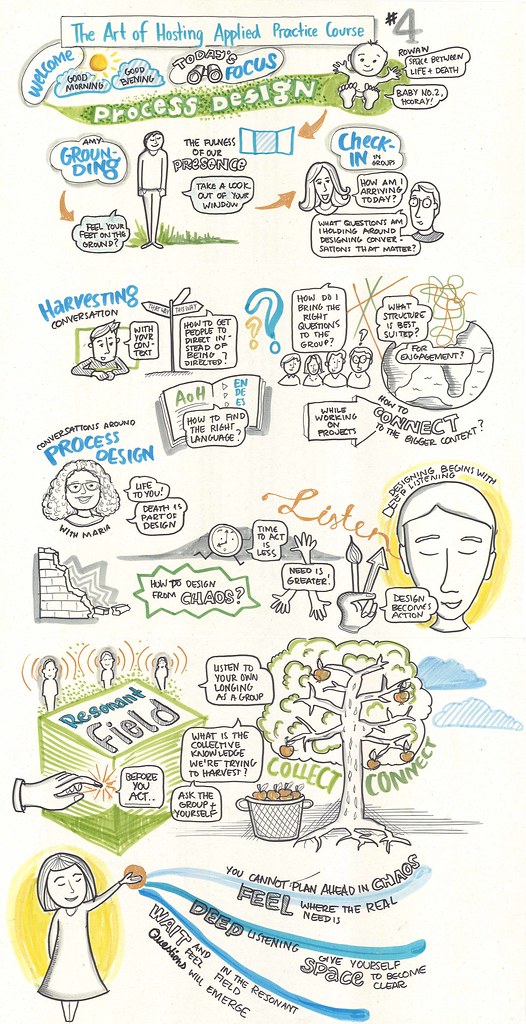
Sketchnote Art of Hosting Process Desing by Anna L. Schiller
# Hosting and harvesting
AoH draws a strong distinction between hosting (holding the space and process so the group can do its best work) and harvesting (capturing what matters so learning and decisions can travel beyond the moment). Harvesting can be notes, stories, visuals, commitments, prototypes, or even “what changed in us,” but it is always intentional: you harvest according to purpose - pdf
If you do not design the harvest, you often get the classic outcome of good conversation with no memory, which is the polite cousin of institutional amnesia. - pdf
# Methods commonly used in AoH spaces AoH is not a single workshop format. It is more like a “kitchen” of participatory methods that can be combined, depending on whether you need divergence, sensemaking, convergence, or decision. Commonly associated methods include Circle, World Cafe, Open Space Technology, Appreciative Inquiry, and other dialogic / participatory structures.
A useful way to think about this is: AoH is the stance and the craft, while individual methods are the move-set you pick up as you practice.
# Principles and stance AoH is often described as “participatory leadership,” meaning the work is to create conditions where people can take responsibility for what they care about, together. That implies a stance: trust in people’s capacity, curiosity over control, and enough structure to support emergence without strangling it.
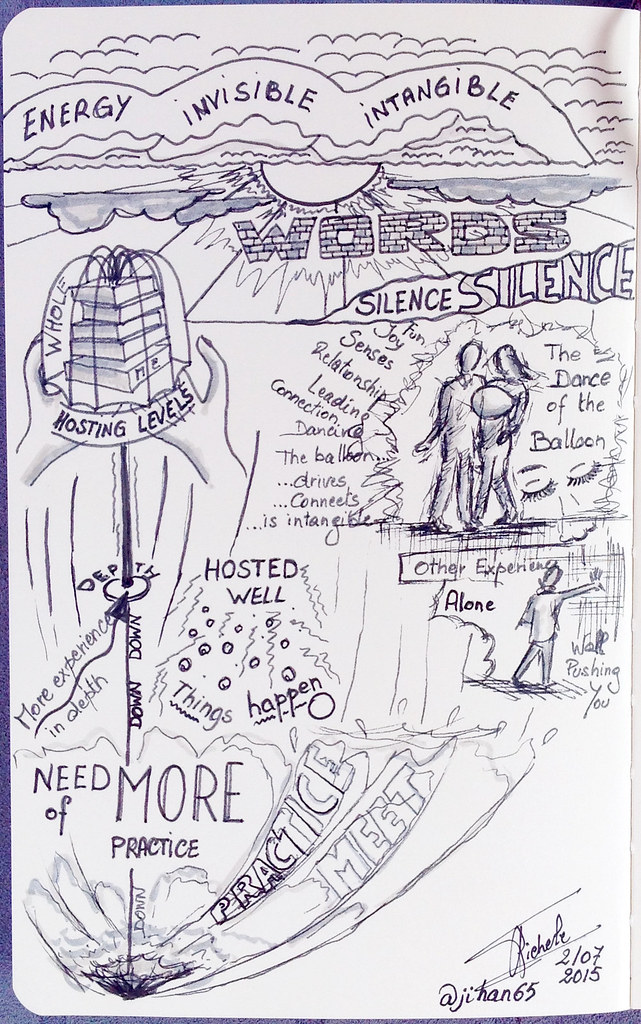
Sketchnotes of gathering of practitioners of Art of Hosting by Claudio Nichele
This stance becomes visible in how invitations are framed, how questions are crafted, how power is handled in the room, and how conflict is treated as information rather than a failure.
# When it works well, and when it doesn’t AoH tends to work best when the topic matters, the group has real agency, and the organisers genuinely want participation rather than rubber-stamping. It is particularly strong for cross-silo collaboration, community governance, strategy in complexity, and any situation where ownership is the limiting factor.
It tends to fail (or be domesticated into “nice meetings”) when leadership wants the appearance of engagement but not the consequences, when outcomes are predetermined, or when the culture punishes honest movement and truth-telling - chriscorrigan.com
# Hitchhiker-style uses AoH is a good fit for volunteer-heavy, story-driven projects because it can turn a diverse swarm of people into a temporary “sensemaking organism” without pretending there is a single command centre. It also pairs naturally with a federated approach: many local hosts running local gatherings that share harvests as portable artifacts, rather than one central event trying to do everything.
A practical pattern is to treat AoH as the social operating system for a Community Driven Development cycle: host a question, run participatory sessions, harvest into a shared wiki, then let teams self-organise into next steps and prototypes.