
Liberating Structures (LS) is a practical “menu” of 33 simple facilitation patterns (often called microstructures) designed to make it easy to include and engage everyone in groups of any size, without needing charismatic leadership or expensive expert facilitation.
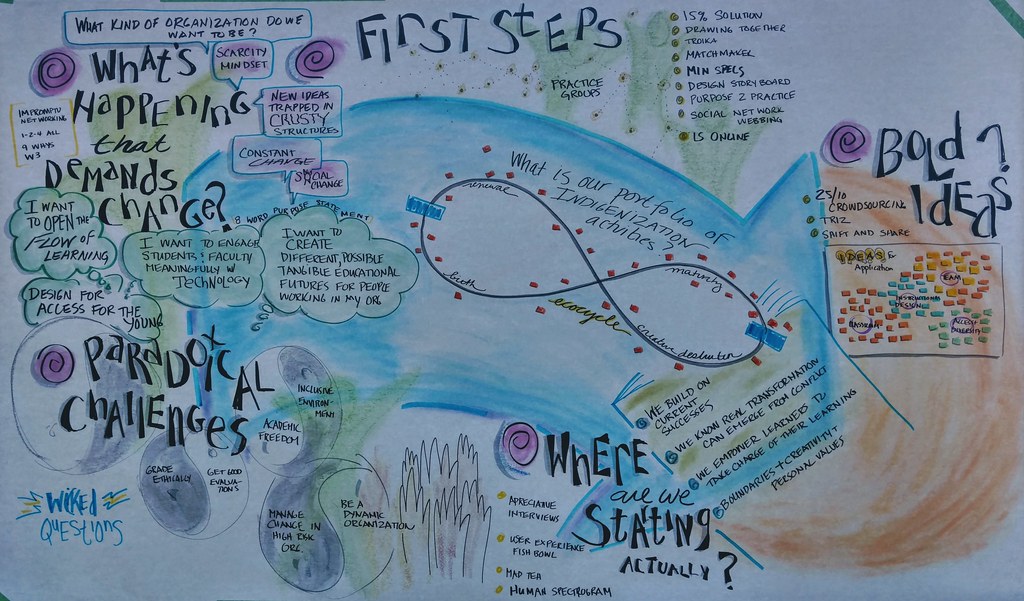
Liberating Structures Gameplan Tapestry by Choconancy1 
LS is essentially an upgrade path for everyday collaboration: instead of relying on a small handful of default meeting formats (presentations, status updates, managed discussions, open discussions, brainstorms), you get dozens of repeatable ways to structure participation so that voice, initiative, and learning are distributed - liberatingstructures.com
# Where it came from Liberating Structures was developed by Henri Lipmanowicz and Keith McCandless and popularised through their book and global community of practice. The emphasis is not on “teaching people to behave better” but on changing the structures of interaction so better behaviour becomes the natural outcome.
# The basic idea LS starts with a quietly radical claim: small changes in how you invite, allocate time, organise groups, and harvest results can produce disproportionately large changes in trust, creativity, and collective ownership. You don’t need a new culture first; you can generate culture through repeated micro-experiences of inclusion that actually work.
The official LS site describes each structure as a “Min Specs” recipe: purpose, time, group configuration, and simple steps that can be reused and mixed with other structures. This makes the methods portable and easy to learn in the flow of real work.
# What makes a “microstructure” Liberating Structures are built from a small set of design elements (the “Min Specs”) that recur in different combinations, such as how participation is distributed, how groups are configured, and how time is used. This is why LS feels modular: once you understand the design logic, you can mix-and-match structures and still keep the interaction lightweight and safe.
# A few famous examples Some LS patterns have become common shorthand in modern facilitation and team practice, because they are quick, reliable, and low-drama.
- **1-2-4-All** is a fast way to move from individual reflection to pairs to small groups to the whole room, producing more ideas and more equitable participation than “who wants to speak first.” - liberatingstructures.com
- **TRIZ** is a structured way to surface and stop counterproductive habits by asking people how to reliably create the worst possible outcome, then noticing which of those behaviours are already happening and deciding what to stop. - liberatingstructures.com
- **Purpose-to-Practice** (P2P) is used to co-design the purpose, principles, participants, structure, and practices of an initiative so that ownership is built-in rather than retrofitted. - liberatingstructures.com
# When it works best LS tends to shine when you want real engagement (not performative participation), when the problem is complex enough that a single “best plan” is unrealistic, and when you want to help groups move from talking-about to working-on. It is often used in change work, strategy, retrospectives, community building, innovation, and any context where the usual meeting defaults are failing.
It is also strong in volunteer or cross-boundary settings because it reduces dependence on hierarchy and makes contribution legible: people can step in, lead a small structure, and step back out without needing positional authority.
# Relationship to Open Space and Art of Hosting If Open Space Technology is a powerful way to let participants generate the agenda, and Art of Hosting is a broader stance and practice of participatory leadership, Liberating Structures is like a dense toolkit of repeatable “interaction moves” you can use inside almost any meeting or gathering.
These approaches blend well: Open Space for self-organised parallel work, AoH for the hosting stance and harvesting discipline, LS for the microstructures that make moments of inclusion reliable.
# Hitchhiker-style use
Liberating Structures is a natural fit for federated, story-driven, builder communities because it turns “vibes” into repeatable social technology. The methods are small enough to embed in workshops, online calls, wiki-gardens, and pod meetings, but strong enough to shift behaviour over time, especially when used consistently - liberatingstructures.com
A simple pattern is to treat LS as the default collaboration layer for Community Driven Development cycles: use 1-2-4-All to generate options, P2P to co-design initiatives, and a closing microstructure to harvest commitments into the wiki as artifacts people can pick up later.